
Indigenous data sovereignty

Natives In Tech Conference 2025 took place Oct 14-16 to support their mission of creating an ecosystem of Indigenous technologists and allies who build and support technology that reinforces Indigenous rights, knowledge, and identity. There is much to learn from Indigenous data sovereignty for anyone who strives for a people-first approach to data. You can watch the conferences presentations on YouTube.
"Over 2 days, over 100 people across 40+ collectives, nonprofits, academic institutions, and orgs convened and, in one way or another, poured into one another. Skills were shared, conversations were frankly beautiful, and minds have been blown. The absolute expansiveness and utter brilliance displayed over and over again by Native community members and offered to one another is humbling..." –Desiree Acosta, President, Board of Directors
We pulled together some resources to support the data sovereignty conversations that took place. Here are some relevant work and resources (not a comprehensive list nor one recommended over another).
Decolonizing Data video
More than a dozen leaders share their perspectives as an introduction to indigenous data and colonizer data in this recording for the 2024 Natives in Tech Conference.
“To us, data isn’t just numbers. It’s our relatives, it’s our stories, it’s our history, and it’s our future” –Ariel Richer
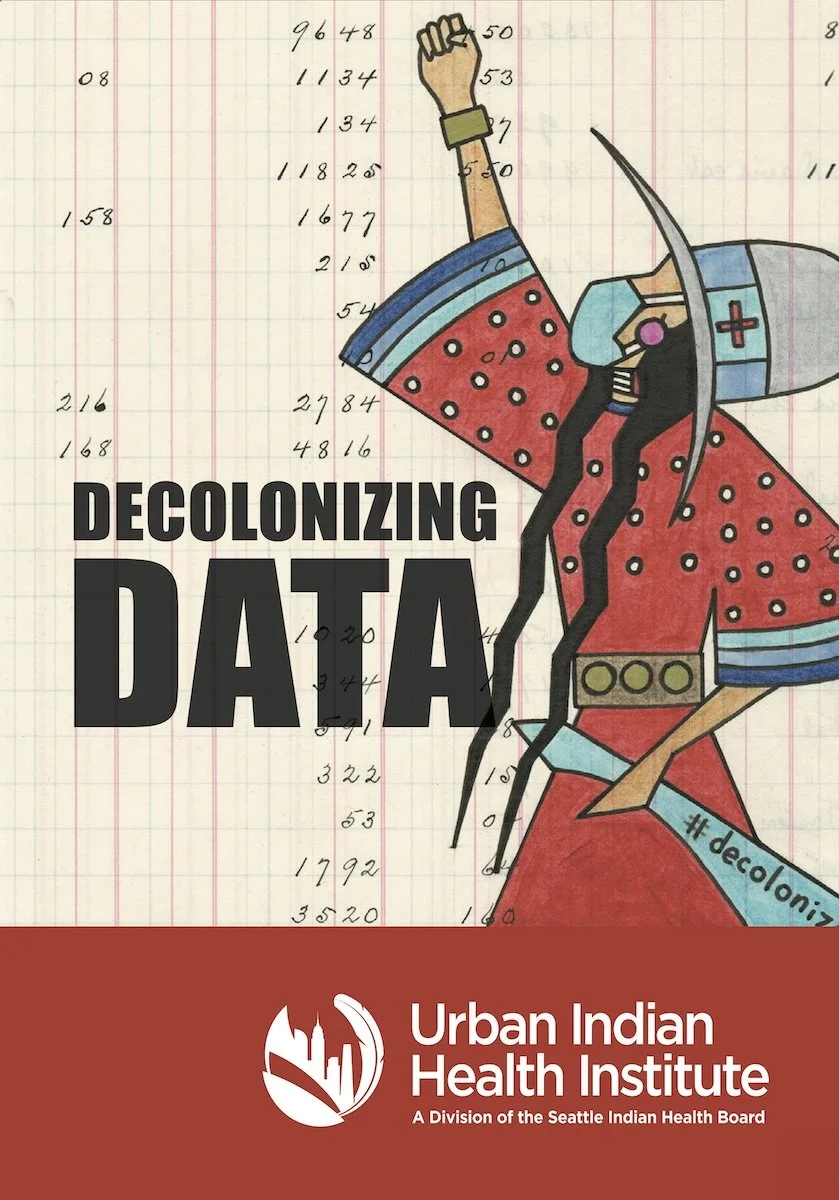
Urban Indian Health Institute’s Decolonize Data Toolkit; artwork by ledger artist John Isaiah Pepion (Blackfeet)
Abigail Echo-Hawk, MA (Pawnee), conference advisor
Director, Urban Indian Health Institute; Executive Vice President, Seattle Indian Health Board
UIHI, a division of the Seattle Indian Health Board, has created a wealth of tools and resources for “decolonizing data, for Indigenous people, by Indigenous people,” including their Decolonize Data Toolkit, a Data Dashboard,Best Practices for American Indian and Alaska Native Data Collection, technical assistance and grants.
Jesse Grey Eagle (Oglala Lakota), conference presenter
Author, Indigenous Systems Thinking, and Founder, Indigenous Futures OS
Angela Marquez (Diné), conference presenter, Mathematics & Data Science Educator
Indigenous Data Sovereignty for K-14 Education
The Collaboratory for Indigenous Data Governance
GIDA - Global Indigenous Data Alliance
Te Hiku Media: Keoni Mahelona and Peter-Lucas Jones
Te Hiku built Whare Kōrero (“house of speech”) which holds more than 30 years’ worth of digitized, archival material featuring about 1,000 hours of te reo native speakers, some of whom were born in the late 19th century, as well as more recent content from second-language learners and bilingual Māori people.
Tech Won't Save Us: Big Tech Won’t Revitalize Indigenous Languages w/ Keoni Mahelona
Faces of the Diaspora: Building Artificial Intelligence Through a Native Lens
“Indigenous data sovereignty is the right of each Tribe to exercise sovereignty over the collection, ownership, and application of data that aligns Indigenous customs, values, and ways of knowing” –Indigenous Data Sovereignty: Toward an agenda
Affirming Indigenous data sovereignty in collaborative wildlife conservation in the era of open data, Oct 2025
Erin Tattersall, Warren Cardinal-McTeague, Isla Myers-Smith, Deborah A. Jenkins, Andrew Cole Burton
The Power of Storytelling in Medicine, Sept 2025
Suzette Brewer (Cherokee Nation)
How Should Epidemiologists Respond to Data Genocide?, January 2025
Abigail Echo-Hawk, MA, Sofia Locklear, PhD, Sarah McNally, MPH, Lannesse Baker, MPH, and Sacena Gurule, MPA
Taking care of knowledge, taking care of salmon: towards Indigenous data sovereignty in an era of climate change and cumulative effects, May 2024
S.E. Cannon, J.W. Moore, M.S. Adams, T. Degai, E. Griggs, J. Griggs, T. Marsden, A.J. Reid, N. Sainsbury, K.M. Stirling, Axdii A. Yee S. Barnes, R. Benson, D. Burrows, Gala'game R. Chamberlin, B. Charley, D. Dick, A.T. Duncan, Kung Kayangas M. Liddle, M. Paul, N. Paul Prince, C. Scotnicki, K. Speck, J. Squakin, C. Van Der Minne, J. Walkus, K. West, Kii'iljuus B. Wilson , The Indigenous Data Sovereignty Workshop Collective
Data genocide, as defined by UIHI, is “the elimination of Indigenous people in data resulting in the non-fulfillment of treaty and trust responsibilities due to ‘lack’ of data on urban and rural tribal communities.”
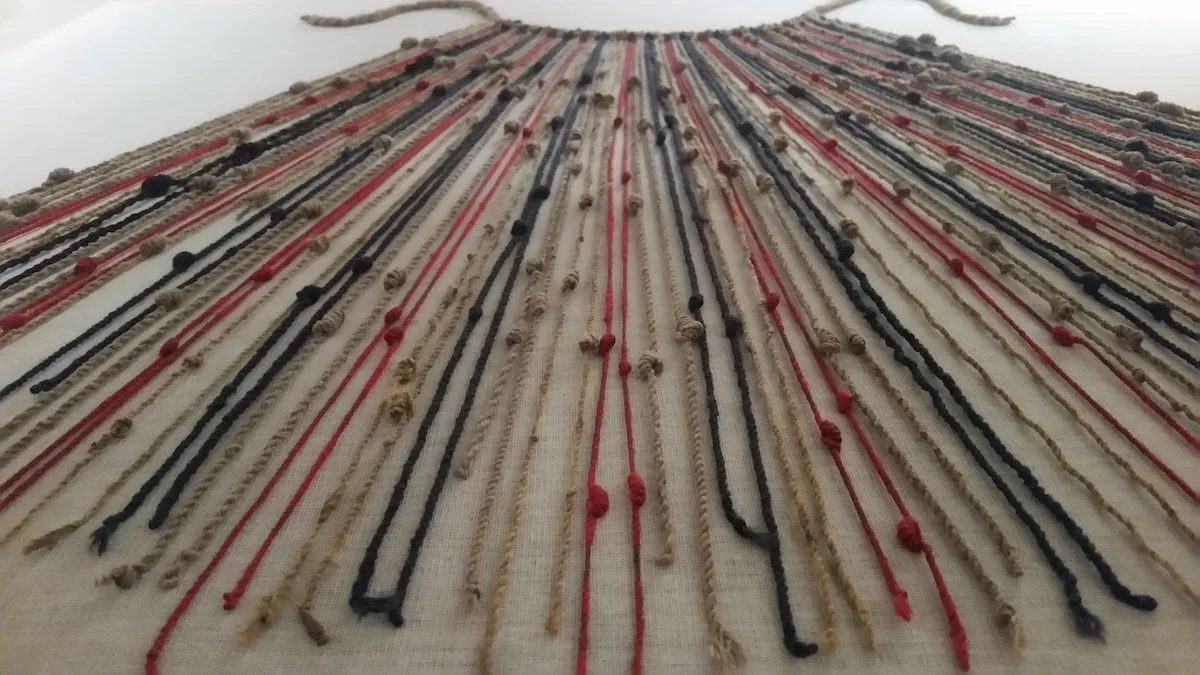
Quipu in the Museo Machu Picchu, Casa Concha, Cusco, licensed under the Creative Commons Attribution-Share Alike 4.0 International license
Decolonizing Data for Missing and Murdered Indigenous People, February 2024
Tiana Teter (Koyukon Athabascan)
‘Data genocide’ drives epidemic of missing and murdered Indigenous people, Aug 2023
The American Bar Association
The Dark Side of Data: The Underrepresentation of Indigenous Communities, May 2023
Jesse Grey Eagle
Decolonizing Data, 2023
Autumn Asher BlackDeer, PhD, MSW
The CARE Principles for Indigenous Data Governance, 2020
Stephanie Russo Carroll, Ibrahim Garba, Oscar L. Figueroa-Rodríguez, Jarita Holbrook, Raymond Lovett, Simeon Materechera, Mark Parsons, Kay Raseroka, Desi Rodriguez-Lonebear, Robyn Rowe, Rodrigo Sara, Jennifer D. Walker, Jane Anderson, Maui Hudson
Decolonizing Data Visualization
Stephanie Evergreen
The khipu code: the knotty mystery of the Inkas’ 3D records
Manuel Medrano and Gary Urton
And don’t forget to check out Cindy Lin’s video presentation from the Natives in Tech Conference: Two Tools for Holding Data Accountable.